The Science behind Crumbed Rubber and Synthetic Turf
A question of safety
There has been a lot of media speculation lately reporting on health and environmental concerns around synthetic grass surfaces. As a result of this speculation, questions have been raised as to whether chemicals in the grass fibres and recycled SBR rubber infill might give off toxins that are harmful to human health.
The issue is not new and has been researched and debated for over a decade. All of that research to date concludes that there is no evidence that there is any elevated human health or environmental risk from ingesting, breathing, or skin contact with synthetic turf grass fibres or the infill or from any Stormwater run-off.
This article is not going to attempt to cite all the research available but if one is interested to delve deeper into this topic and the internet, a good starting point is the Synthetic Turf Council’s website includes many studies on the human health and environmental safety of synthetic turf and crumb rubber.
The issue around SBR rubber
The third generation of surfaces, engineered for sports such as football and rugby are manufactured from longer polyethylene fibres that is filled with sand (for stability) and rubber granules (for shock absorption, elasticity, and suitability for sliding) and provide better player safety and comfort, and playability that is equal to or better than grass (more playing hours, no cancellations and a cost-benefit).
Concerns about toxins
Much of the current concern is around the rubber crumb (SBR) which is mostly recycled from old car and truck tyres. Rubber is a complex mixture with some components possessing toxic and carcinogenic properties. Tyre rubber crumb contains a range of organic contaminants and heavy metals that can become volatile, emitting toxins into the air and/or leach into the percolating rainwater, posing a potential risk to the environment and human health. Parents and consumer groups are concerned that these toxins could then be absorbed into the body through skin contact, inhaled or ingested at levels that might constitute a health risk.
Research conclusions – it all depends on…
Investigating the health and environmental effects of synthetic surfaces is pretty complex. Within the extensive research literature, there are reports that conclude that under certain conditions and in particular circumstances there may be health and environment issues while others that conclude the opposite, with the position being adopted invariably depending on what was investigated, how it was investigated and how findings were interpreted.
TigerTurf constantly monitors the research conducted around these issues as well as continues to undertake its own research and implement measures to ensure its products are safe.
In 2013, TigerTurf collaborated with Auckland Council on research undertaken a Michaels Avenue Reserve in Auckland. The community is a “no-spray” area and local community groups voiced their concerns over the environmental and health impacts of the synthetic turf’s rubber infill. The on-going research measures the toxicity levels coming off the surface with initial results of the independent testing commissioned by the council finding no cause for concern.
What the experts say
Other studies have measured potential toxicity levels of the crumb rubber against the European Union’s EN 71-3 standards which have shown toxicity is either not detectable or, where detected, are well below category III requirements. These standards, set in 2013 as part of Europe’s Toy Safety Directive, are widely recognized as the most advanced in the world.
Health risk assessment studies suggested that users of artificial turf fields, even professional athletes, were not exposed to elevated risks. And no scientific study has found an association between exposure to artificial turf and cancer.
A widely referenced study by Zhang et al (2008) concluded that ‘ingestion (of PAHs) is unlikely’ and that ‘this finding will undoubtedly provide a degree of comfort to health officials and the public’. It also found that lead content in the rubber filler and in the ‘new generation’ fibre was low when compared to health ¬based lead concentration soil standards.
Other studies have shown that the environmental impacts of artificial turf fields are often lower than equivalent grass fields especially when taking into consideration the pesticides, herbicides and fertilisers needed to maintain a quality pitch.
Alternative options
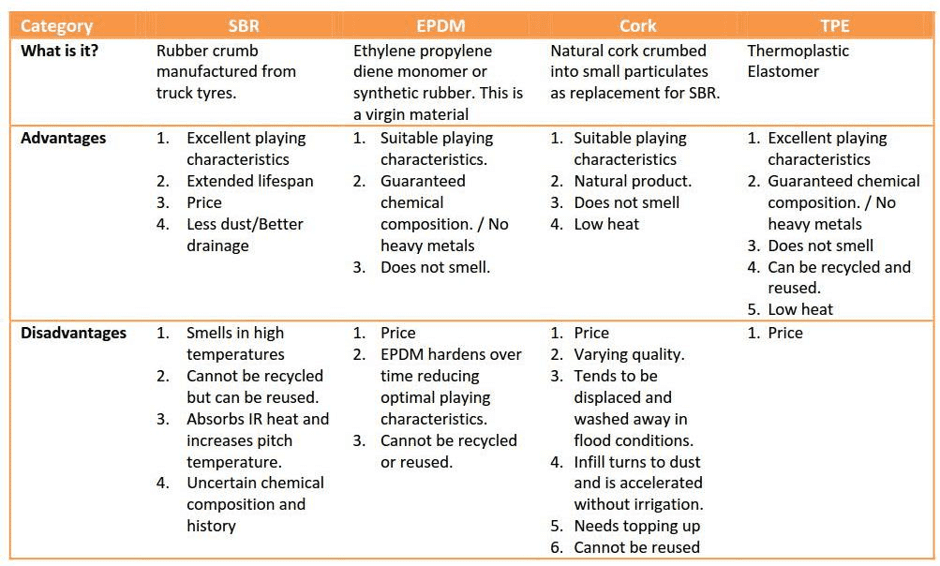 SBR rubber is not the only infill material that can be used in synthetic turf systems and manufacturers are continually researching options that might provide a better solution. Besides the SBR rubber granules, other options currently available are EPDM (Ethylene Propylene Diene Monomer), a synthetic rubber; TPE, a Thermoplastic Elastomer, and Cork. The following table outlines the advantages and disadvantages of each.
The options available have both advantages and disadvantages. These should be evaluated based on each particular project and the requirements of the community.
Summary
Whilst acknowledging that there are those who have concerns about synthetic surfaces, it also needs to be acknowledged that there is a wealth of evidence from reputable and independent sources indicating that, to the best of our knowledge, synthetic surfaces are safe for humans and the environment.
Of course, the data isn’t perfect and there are a few issues to be wary of. None of the studies are all-inclusive; they don’t test each brand of turf or weed out every potentially toxic ingredient. There are gaps in the research and it’s those gaps that are fuelling public fears and speculation, such as the worry that football players could be getting cancer from turf. But it needs to be said that some of the more hysterical discussions of the potential dangers of synthetic surfaces need to be countered by a more balanced reading of the research into synthetic surfaces.
There are many who are confident, including national and international sports leagues, universities, public and private school systems, parks departments and municipalities that continue to make informed decisions to install synthetic turf.
Parents and consumer groups who are concerned that the emitting of toxins into the air and/or leaching into the percolating rainwater, that could then be absorbed into the body through skin contact, inhaled or ingested at levels that might constitute a health risk should read the numerous research studies completed on these issues.
With few exceptions, respected researchers have found no evidence of exposure or exposure at such low doses that there’s little risk of harm. In fact, some studies have found that if there is an uptake of chemicals, it’s at doses equivalent to those found in food and the rest of the environment.
If this issue is still a concern it is recommended that cities or school systems consider doing their own tests on the brand of turf they want to buy.
How do synthetic football pitches compare with natural turfs, point by point?
Artificial grass pitches for professional football matches? A topic hotly debated by fans of artificial turf pitches and those passionate, increasingly nostalgic, fans of natural grass pitches.
So what are the pros and cons of natural vs. synthetic football pitches? Have synthetic turfs brought benefits to football beyond those of a natural grass pitch? You may well have strong feelings about 3G pitches, one way or another, and both sides of the argument present some valid points. Let’s take a closer look at the pros and cons of natural pitch versus an artificial football pitch.
Natural grass football pitches: what we love about them
Professional players generally argue the merits of natural grass football pitches over synthetic turf in terms of performance characteristics: ball roll, bounce, and player experience. The natural surfacing is, of course, the traditional specification for pitches used in competitive football leagues.
We’ve even heard that some supporters of natural grass pitches say that the synthetic grass football turfs cause more injuries to players and can hold potentially dangerous bacteria within the artificial fibres. If you have some facts to back up these suggestions, we’re listening. Your comments are welcomed and will be followed up.
Congo Brazzaville coach, Claude Le Roy, expressed concerns over the playability of synthetic turf after his team had earlier been defeated 2-0 by Bafana; he felt his side was disadvantaged by playing on the synthetic grass pitch, being used to the playing qualities of a natural grass pitch.
Natural grass football fields: what we don’t like so much
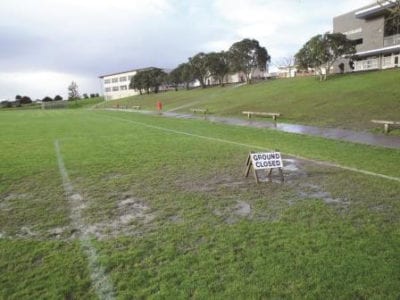 Mud, dust, bare patches and the time (money) spent on maintaining a natural grass football pitch at the level required to give players and spectators an enjoyable game. Enough said. It seems that practical, everyday reasons are generally the deciders for most clubs. Despite our emotional and reasoned attachment to natural grass football fields, it is now true that recent innovations in artificial grass football fields have led to these becoming much more popular than previously. Let’s look at why this might be so.
Artificial football turfs: the real story
Although some players prefer the performance characteristics of natural grass and regard it as the superior surface, many clubs and teams choose to have 3G football pitches installed. Today’s advanced synthetic football surface has been designed to reproduce the playing qualities of natural grass, so the effect on performance should be minimal as long as the pitch surface system is installed and maintained correctly.
The fibres used in TigerTurf football surfaces are soft, non-abrasive fibres that are long enough and strong enough to hold the ball. The texture allows the player to carry out sliding tackles and other skills safely, controlling ball roll and bounce as does natural grass, only more consistently. Our specialised football turfs have been well tested to meet FIFA international standards.
Besides, standing on the side-line of a grass field, ankle-deep in mud, cheering on players who are skidding and sliding in soggy conditions is only fun when filtered through the mists of nostalgia.
Synthetic football pitches overcome difficult climatic conditions
Artificial pitches play safely and consistently in just about any weather conditions. If you live with dry conditions, you’ll know all about hard, dusty, dry football surfaces that break up, making play erratic and injuries inevitable. Irrigating is expensive and often just not possible, depending on the availability of water.
On the other hand, if you live with a wet climate, your club or school will want to find out more about synthetic grass football surfaces. With a porous surface system that allows rainwater to drain away quickly in wet weather, these synthetic turfs will solve several problems for you. Installing effective drainage when football turfs are installed can turn the soggiest sports grounds into useable sports facilities. When space has to be found for more sports fields, an artificial sports turf, expertly installed, can turn the unlikeliest piece of ground into a useful asset that can also be hired out to other groups, contributing to your club’s finances.
Synthetic grass fields stay open throughout the football season, even in wet areas, giving teams consistent playing conditions whatever the weather, game after game, week after week, and for all the practices in between. And that’s going to keep your team’s performance sharp!
Artificial grass football fields are low maintenance and more durable than grass
Football clubs, schools, and councils with a tight budget will appreciate the benefits of installing a modern, technical football surface: low maintenance, durable, dependable, environmentally sound and good looking too.
As our populations increase, more people are playing football, leading to intensive use of the existing football facilities. On a natural football field, this increases maintenance costs and the pitch inevitably suffers from the extended playing time as summer tournaments succeed the winter competitions.
Artificial grass is more durable; while still retaining the look and playing characteristics of natural turf, it stands up to continuous use, enabling clubs to cover the initial cost of installing a high-performance synthetic football turf by enlisting more players, and by renting the facility out to other teams and organisations.
Safety of players on synthetic turf
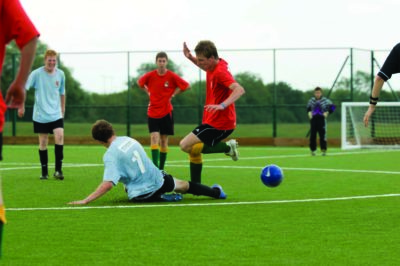
Synthetic football surfaces have been designed to improve the safety of players and cut down injuries that keep you off the turf. The even surface maintains its integrity, and without ruts and bumps, you’re not going to take so many tumbles and stumbles. You’re also less likely to slip and skid, avoiding the pulled muscles and ripped tendons that keep you out of play.
Shock pads can installed beneath the turf surface to reduce impact injuries and long-term damage to joints, good news for players who play for fun and fitness into (and beyond) middle age.
On technical synthetic sports surfaces, players enjoy consistent playing conditions through drought or rain, noon or night-time on a surface that closely replicates the playing conditions of a well-maintained natural turf. Unfortunately, natural turfs rarely do the same. By their very nature, they are variable throughout the day and the seasons, as you’ll know only too well.
Versatile sports surfaces
Yet another point in favour of artificial football turfs is that some of these are designed to accommodate more than one sport. Of course, a natural turf can do the same, but then there is the task of marking it for each sport…
A modern turf can be permanently marked for 3 or 4 sports, which gives you flexibility in planning how to use the space you have available and adds versatility and value to your sports facility without blowing your budget.
Conclusion
You may feel strongly that your team plays better on natural grass. This may well be true, particularly for teams who practice on natural grass. However, it will, of course, only be true of a top-quality pitch. If we consider additional factors such as climatic challenges and the cost of maintaining these pitches at peak condition, they do become unsustainable in the face of the heavy demand placed on most football facilities these days.