

How to Choose the Best Artificial Grass for Home Gyms in NZ

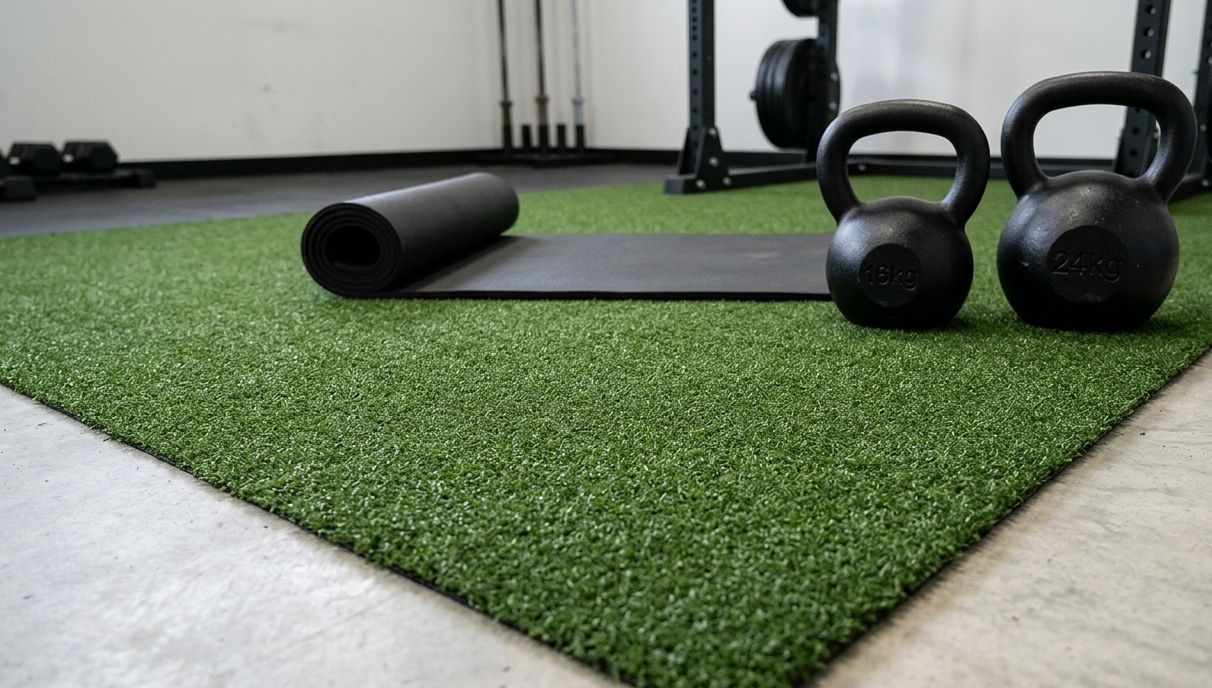
Turf in home gym

Home gyms have come a long way. What used to mean a dusty treadmill in the garage now often includes sleds, barbells, plyo boxes, battle ropes, and more. Synthetic turf has become the go-to flooring choice for serious home gym setups across New Zealand, and for good reason.

It handles heavy equipment without complaint, cushions impacts better than bare concrete, looks sharp, and is straightforward to keep clean. But not all synthetic turf performs well under gym conditions. Getting the specification right from the start makes a significant difference to both performance and longevity.

Why Synthetic Turf Works So Well in a Home Gym

Before getting into specifications, it is worth understanding why turf has become the preferred surface for functional fitness spaces.

  •       Versatility: Turf works for sled training, barbell work, agility drills, stretching, and general movement without the need for multiple different floor surfaces.
  •       Durability: A quality gym-spec turf surface holds up to repeated heavy impacts and foot traffic far better than foam tiles or rubber matting over time.
  •       Cleaning: Chalk, sweat, and rubber deposits brush off turf more easily than they clean off hard flooring. A stiff brush and occasional hose-down keeps the surface fresh.
  •       Comfort: The combination of turf fibres and an infill or shock pad underneath creates a noticeably more forgiving surface for extended training sessions.

Pile Weight: Why It Matters More in a Gym Than a Garden

Pile weight refers to the weight of turf fibres per square metre and is one of the most critical specifications for gym applications. In a residential lawn, pile weight influences appearance and softness underfoot. In a gym, it directly determines durability and performance under load.

Heavier gym equipment, repeated sled pushes, and constant directional foot traffic exert far more mechanical stress on a turf surface than a family crossing a backyard. A lighter residential product used in a gym context will flatten, mat, and break down significantly faster than its rated lifespan suggests.

Pile weight guidance for gym applications:

  •       Lighter residential turf under 2,000 dtex: Suitable for low-intensity use only. Not recommended for equipment-heavy or high-frequency training setups.
  •       Mid-weight turf 2,000 to 3,000 dtex: A workable choice for mixed-use garage gyms with moderate training intensity and limited heavy equipment.
  •       Heavier performance turf 3,000 dtex and above: The right choice for serious training environments with sleds, barbells, and regular high-intensity sessions.

TigerTurf’s Tournament 1000 sits in the higher pile weight category and handles the mechanical demands of gym use comfortably. It is designed for high-performance sports applications and translates directly to the demands of a home gym environment.

Shock Pads and Underlay: Do You Need One?

One of the most common questions for home gym turf is whether a shock pad underlay is necessary. The honest answer is: it depends on your training style and what the turf sits on.

Shock pads are foam or rubber underlays installed beneath the turf to provide cushioning and impact absorption. In sports facilities they are used to meet impact attenuation standards. In home gyms they serve a similar purpose.

When a shock pad is recommended:

  •       High-impact training: Olympic lifting, box jumps, and repeated weight drops benefit significantly from a shock pad. It reduces injury risk and cuts noise transmission, which matters if your gym is above living areas or close to neighbours.
  •       Concrete subfloor: Turf directly over concrete is noticeably firmer underfoot than over aggregate or earth. A shock pad takes the edge off and makes longer sessions more comfortable on joints.
  •       Joint health considerations: If you or regular training partners have existing knee or ankle issues, the additional cushioning is worth the added cost.

When you can skip the shock pad:

  •       Low-impact training only: If your gym is primarily cardio equipment, stretching, and light resistance work, the turf alone over a prepared base will likely be sufficient.
  •       Compacted aggregate or earth base: These substrates naturally provide more give than concrete, reducing the need for a dedicated underlay.

Most shock pads used beneath synthetic turf range from 10mm to 40mm in thickness. Your TigerTurf installer can recommend the right specification based on your training style and existing subfloor conditions.

Drag Resistance: Getting the Surface Right for Sled Training

Sled pushes and sled pulls have become a staple of functional fitness training, and turf is the ideal surface for them. But the drag characteristics of the turf, meaning how much friction a sled encounters as it travels, vary considerably between products.

Drag resistance is influenced by:

  •       Pile height: Shorter pile creates more consistent sled contact and predictable resistance. Longer pile can cause sleds to dig in, making movement uneven and harder to control through a full push.
  •       Infill type and density: Sand infill creates higher drag than rubber crumb. No infill, which is common in gym-spec turf products, gives the most consistent and controllable sled surface.
  •       Fibre texture: Some fibres include a surface texture designed for sports traction. This affects sled behaviour as well as footwear grip underfoot.

For a dedicated sled lane, a shorter pile height in the 12mm to 20mm range with minimal or no infill generally gives the most satisfying training experience. If your gym has a defined sled run alongside a general training zone, consider specifying each area differently to get the best of both.

Choosing the Right TigerTurf Product for Your Gym

As New Zealand’s only local synthetic turf manufacturer, TigerTurf can help you match product specifications precisely to your training requirements. For home gym applications, the main considerations are:

  •       Durability under heavy and frequent training loads
  •       Surface consistency for predictable movement and sled performance
  •       Easy maintenance: chalk, rubber, and sweat all need to clear readily
  •       Heat management in poorly ventilated garage or shed gym spaces

New Zealand’s summer temperatures, particularly in garages with metal roofing, mean heat retention is a genuine consideration. TigerTurf’s Summer Envy and Tournament 1000 both include UV stabilisation and are designed to hold their performance and appearance under the high UV and heat conditions common across the North Island.


Practical Installation Tips

  •       Define your zones early: Sled lanes suit shorter, denser pile. Stretching and recovery zones benefit from a softer product. Specifying zones from the outset gives you a purpose-built space rather than a compromise.
  •       Plan seam placement carefully: Avoid seams running through the middle of a sled lane. Seams in high-friction zones wear faster than the surrounding surface and will be felt underfoot during training.
  •       Edge finishing matters: Aluminium or rubber edging gives your installation a clean finish and prevents edges lifting under heavy equipment or repeated foot traffic near the perimeter.
  •       Allow for maintenance access: Your gym layout should let you brush and vacuum the surface without moving every piece of equipment. Plan this before committing to a furniture arrangement.

If you are also planning a broader outdoor space alongside your gym, our backyard renovation artificial grass planning guide covers drainage, base prep, and product selection in detail.

For multi-use outdoor gym or sports facility setups, the TigerTurf sports surfaces includes performance-grade options designed for exactly these demands.

Telarc
World Bowls
FIH Preferred Supplier
ITF Foundation
Fifa
World Rugby
0
    0
    Your Cart
    Your cart is emptyReturn to Shop