March 25, 2026

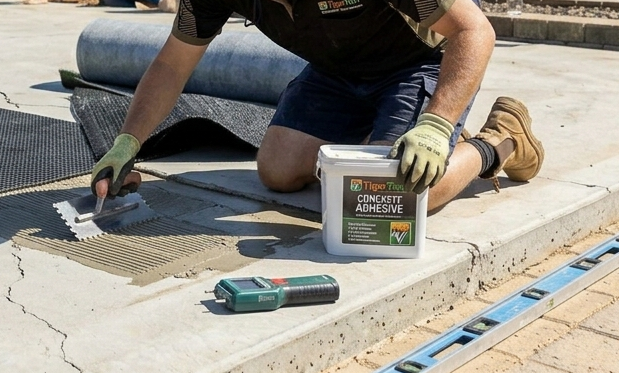
It’s a question TigerTurf gets asked regularly: can you install artificial grass directly over concrete? The short answer is yes, and in many situations it’s actually simpler and faster than installing over natural soil. But there are several important things to understand before you proceed, because the success of the installation depends heavily on how well you prepare the surface and address drainage.
Here’s what to know before you get started.
Concrete offers something soil doesn’t: a firm, stable, level surface that won’t shift or settle over time. That stability is actually one of the things that makes concrete a good foundation for synthetic turf. You don’t need to excavate, compact a base, or build up layers of crushed rock the way you would on a soil site. In many cases, particularly for balconies, courtyards, pool surrounds, and small patios, laying turf over concrete is the fastest and most practical option available.
That said, concrete also creates challenges that soil doesn’t. Two in particular need to be addressed before any turf goes down: drainage and comfort underfoot.
Concrete doesn’t absorb water. Unlike a compacted crushed rock base, which allows water to filter through and drain naturally, concrete will direct any water that falls on it to wherever it can find an exit. If that exit isn’t well positioned, water can pool beneath the turf and cause a range of problems including mould, odours, and deterioration of the turf backing over time.
Before installing turf over any concrete surface, you need to assess how water currently moves across it. Pour water on the surface and watch what happens. If it drains quickly toward an outlet, you’re in good shape. If it pools in low spots, you’ll need to address that first.
For surfaces that drain poorly, two options are common: drilling small drainage holes through the concrete at low points (typically 8 to 10mm wide, spaced every 50cm or so), or installing a permeable drainage mat or tile system between the concrete and the turf. This creates channels for water to move laterally and escape, rather than sitting trapped beneath the surface.
It’s also worth noting that any turf product you lay over concrete should be secured with a water-permeable adhesive, so that drainage isn’t blocked at the fixing points.
Concrete is hard. Synthetic turf on its own provides some cushioning, but for spaces where people will be sitting, children will be playing, or bare feet will be the norm, the combination of turf directly on concrete can feel firmer than expected.
This is where shock pad underlay comes in. A shock pad or foam underlay layer installed between the concrete and the turf improves underfoot comfort significantly, adds a small amount of thermal insulation (which helps with surface heat), and for playground-type applications, provides important impact absorption for child safety.
For purely decorative applications, like a narrow courtyard or a rooftop entertaining area used by adults, shock pads are a nice-to-have. For family spaces, pet areas, and any application where children will be running and playing, they’re strongly recommended.
Even though concrete eliminates much of the base preparation work involved in a soil installation, the surface itself still needs attention before turf goes down.
The concrete should be thoroughly cleaned. Dirt, algae, oil, and any cleaning chemical residue can affect how the adhesive bonds and may cause issues over time. A good pressure wash and scrub, followed by adequate drying time, is the minimum. Any significant cracks or uneven spots should be filled with a concrete repair compound and allowed to cure fully before installation begins.
The surface must also be genuinely level. Unlike soil, where minor undulations can be addressed during base preparation, concrete is what it is. Any dips or humps in the surface will be visible through the turf, and uneven spots can cause water to pool. If the existing concrete has significant level issues, a self-levelling compound can be used to correct them.
Not all turf products are equally suited to concrete applications. For balconies, courtyards, and pool surrounds, you generally want a product with a shorter to medium pile height that sits close to the surface, looks tidy, and drains efficiently. TigerTurf’s landscape grass range includes options designed for exactly these applications, and the team can advise on which product is the right fit for your specific space.
For pool surrounds in particular, the turf must be UV-stable enough to handle direct exposure near water, and the drainage system beneath needs to handle the water that comes off wet bathers and regular hosing. TigerTurf products include UV protection as standard, backed by a warranty of up to 10 years.
Smaller concrete areas like balconies, small courtyard spaces, and covered areas are often manageable as DIY projects for a confident homeowner. Larger areas, pool surrounds, and any site with drainage complexity are better handled by an experienced professional installer who can assess the surface condition, recommend the right system, and ensure the finished result is clean, secure, and long-lasting.
Explore TigerTurf’s full range of landscape artificial grass solutions, including products suited to hard surface applications.
How can we help?
Whether you need a surface solution for sports, leisure, or landscaping, our product range and expertise are second to none. Our experts are with you all the way, from selection to maintenance: we pride ourselves on our exceptional customer service. So, what would you like to do next?